
The Market HasChanged, and SellersNeed the Truth
Australia's property market is entering a different era. Sellers who keep measuring their home against yesterday's prices may find the market has moved before they have.
By Tony Lawson · Real Estate Agent, South Australia

A Conversation We Need to Have
There is a conversation I believe we need to have about Australian property. It is not a particularly comfortable one. And as a real estate agent, it would certainly be easier to tell owners that everything will eventually return to what they became accustomed to.
I don't believe that's responsible.
For years, Australian homeowners watched values climb at extraordinary rates. Properties sold quickly. Records were broken. Cheap money increased borrowing capacity, buyers competed against each other, and sellers became accustomed to holding much of the negotiating power.
Eventually, something very dangerous happened. Exceptional conditions started to feel normal.
They weren't.
Australian sellers now need to understand that the market they remember may not be the market to which we are returning.
Four Years That Changed Our Expectations
The pandemic property boom was extraordinary. Ultra-low interest rates, enormous monetary and fiscal stimulus, changing household behaviour, limited stock and intense competition created conditions in which property values increased dramatically.
Then the environment changed. Inflation returned. Interest rates increased. Mortgage repayments climbed. Borrowing capacity became more constrained. And now the housing market itself has softened.
The Reserve Bank of Australia said in August 2026 that conditions in the established housing market had weakened more than expected, with housing prices declining over recent months after a long period of very strong growth.
That sentence deserves attention. This isn't a real estate agent saying the market feels softer. It is Australia's central bank.
The Mathematics of Property Has Changed
Property prices ultimately depend upon something considerably less emotional than what an owner believes their home should be worth. They depend upon what somebody else can pay. And for most Australians, that means what a bank will allow them to borrow.
Higher interest rates don't simply increase repayments for existing homeowners. They affect prospective buyers. A household that could previously borrow enough to compete at $800,000 may no longer have that capacity.
What the same household can borrow as rates rise
Indicative borrowing capacity for an unchanged income, in thousands of dollars. The property did not change. The buyer's cheque did.
Illustrative modelling by Tony Lawson. Principal and interest over 30 years with a serviceability buffer. Not a lending assessment.
The property hasn't changed. The kitchen hasn't disappeared. The land hasn't become smaller. The neighbourhood hasn't moved. But the financial capacity of the buyer has changed.
Sellers can ask whatever they want. The market doesn't have to pay it.
The Lending Numbers Should Concern Sellers
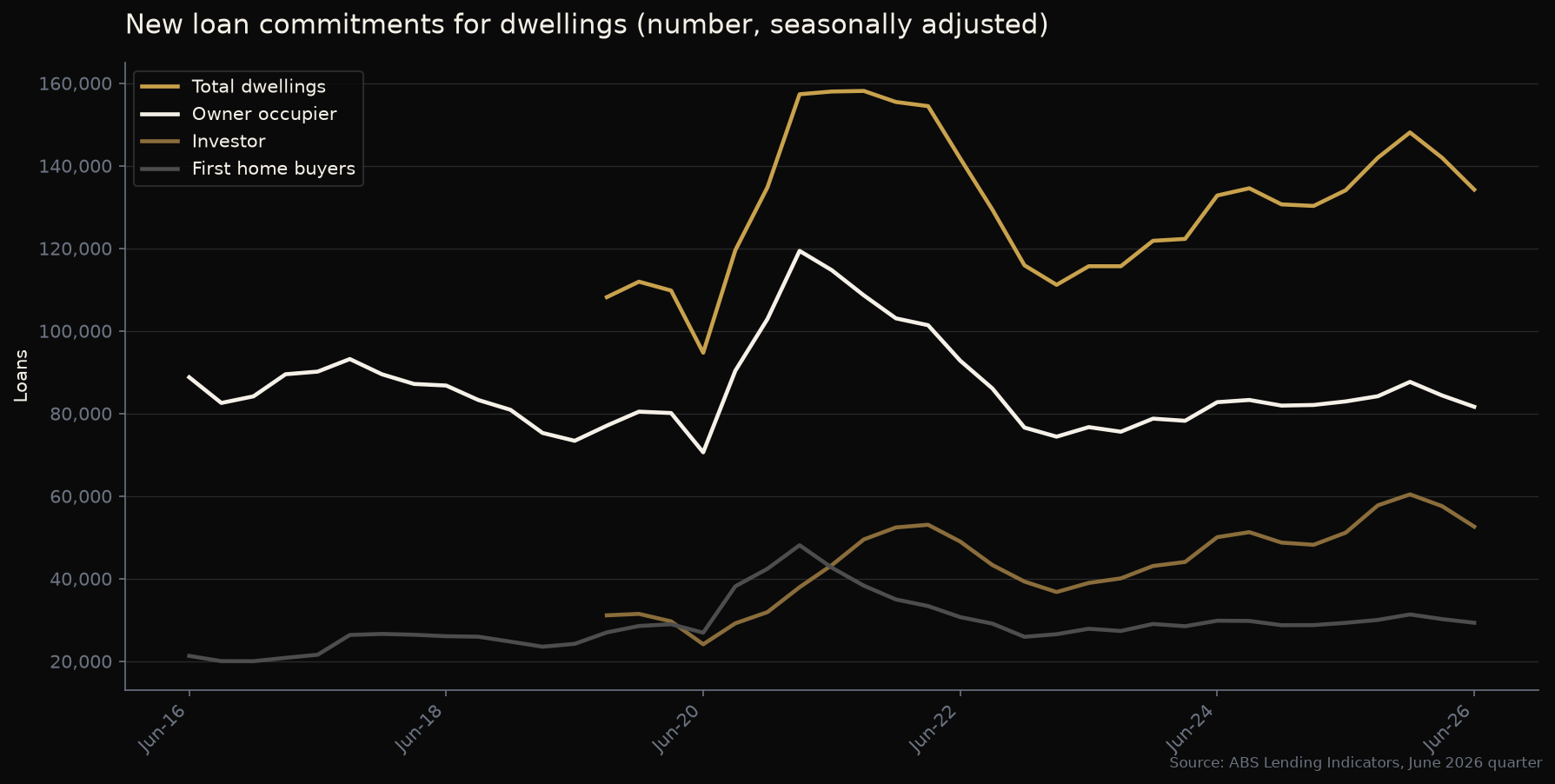
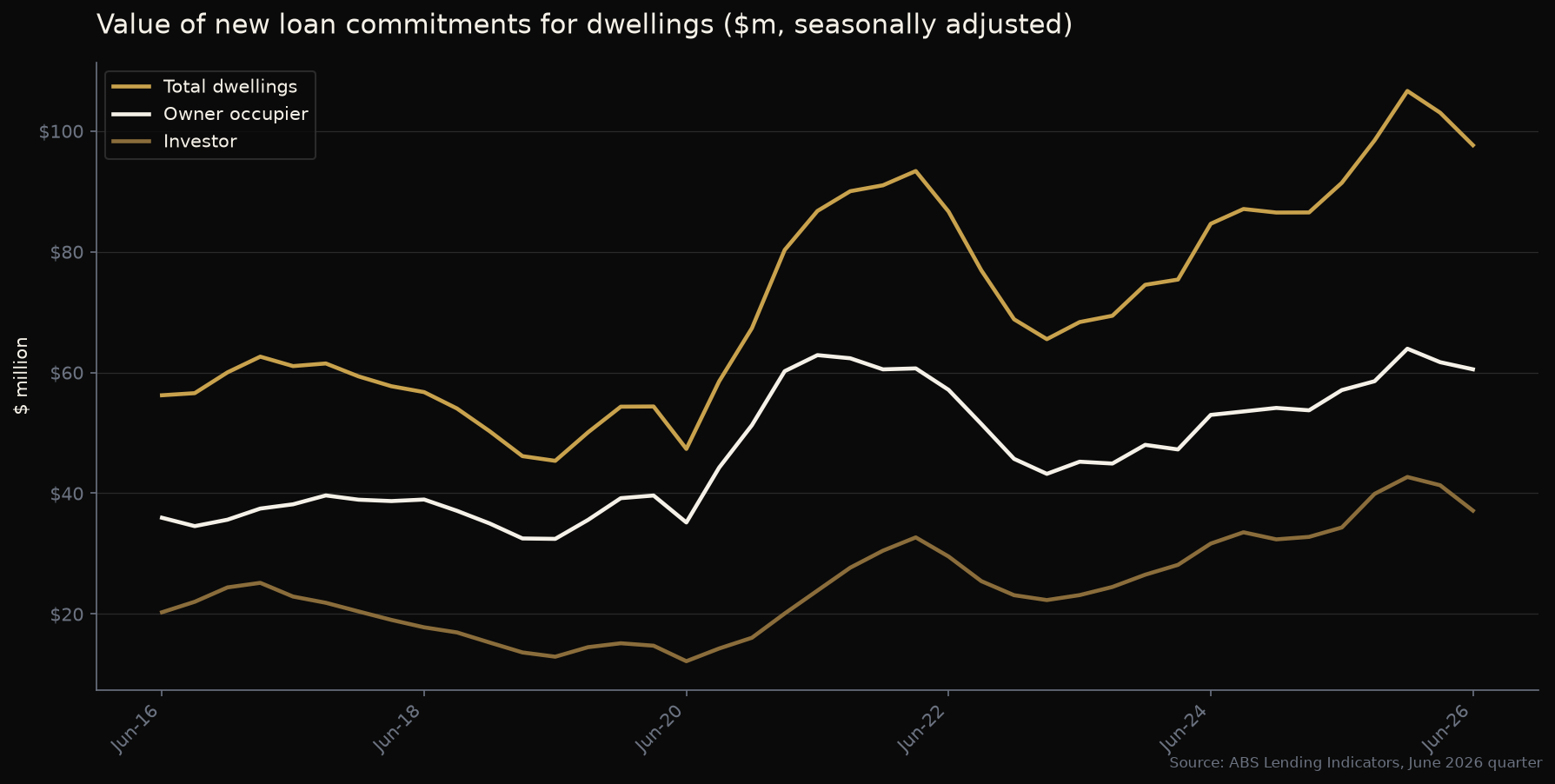
The latest ABS lending figures demonstrate just how quickly conditions have changed. In the June quarter of 2026, the number of new dwelling loan commitments fell 5.4 per cent. Owner-occupier commitments fell 3.3 per cent. Investor commitments fell 8.6 per cent. And the value of new investor commitments fell 10.2 per cent in a single quarter.
Those are not insignificant movements.
New housing loan commitments, June quarter 2026
Quarterly change. Every measure moved the same way, and investors moved hardest.
Source: Australian Bureau of Statistics, Lending Indicators, June quarter 2026.
Source — Australian Bureau of Statistics
Lending Indicators, June quarter 2026
https://www.abs.gov.au/statistics/economy/finance/lending-indicators/latest-release
Media release — ABS
New home loans fall 5.4 per cent in June quarter
https://www.abs.gov.au/media-centre/media-releases/new-home-loans-fall-54-cent-june-quarter
The RBA has independently described what is happening as a sharp decline in new housing loan commitments, driven particularly by investors.
And lending rules have tightened
From 1 February 2026, APRA activated limits on high debt-to-income residential mortgage lending. Banks can have only up to 20 per cent of new owner-occupier lending and 20 per cent of new investor lending at a debt-to-income ratio of six times income or greater, subject to the framework's definitions and exemptions.
APRA's debt to income ceiling, active from 1 February 2026
Banks may write no more than 20 per cent of new lending in each category at six times income or above, subject to the framework's definitions and exemptions.
Source: Australian Prudential Regulation Authority, activation of debt to income limits.
Source — APRA
Activation of debt-to-income limits as a macroprudential policy tool
https://www.apra.gov.au/news-and-publications/activation-debt-income-limits-macroprudential-policy-tool
Explanation — APRA
Activating debt-to-income limits as a macroprudential policy tool
https://www.apra.gov.au/news-and-publications/activating-debt-income-limits-macroprudential-policy-tool
But let's be accurate about the banks
There is a temptation during a falling market to say the banks have stopped lending. They haven't. In fact, the RBA says funding remains readily available to Australian banks, households and businesses.
What has happened is more nuanced, and potentially just as important for property.
- Interest rates have reduced borrowing capacity.
- New housing loan commitments have fallen sharply.
- Investor activity has weakened.
- High debt-to-income lending is now restricted.
- Housing credit growth has begun easing.
- Falling values themselves can eventually feed into weaker housing-credit growth.
So we don't need to exaggerate what is happening. The actual numbers are concerning enough.
One Brutal Principle Sellers Need to Understand
There is something I sometimes have to explain to property owners, and it can be one of the hardest conversations in real estate.
Your house does not know what you owe the bank.
It does not know how much money you need for your next property. It does not know what you spent renovating it. It doesn't know what your neighbour received eighteen months ago. And it certainly doesn't know what an online estimate once said it was worth.
The market knows only what today's strongest genuine buyer is prepared and financially capable of paying. That is the price. Everything else is an expectation.
Yesterday's price can become tomorrow's regret
Imagine a seller receives a genuine offer of $720,000. They reject it because somebody told them twelve months ago that their property should achieve $800,000. They wait. The market moves another 5 per cent. Suddenly $720,000 looks remarkably attractive. But that buyer has disappeared.
The arithmetic of holding out
A worked example. In a rising market time rescues an ambitious price. In a falling market it charges rent on it.
Worked illustration only. Individual results depend on the property, the campaign and the buyers in front of you.
This is one of the fundamental differences between selling into a rising market and selling into a falling one. In a rising market, time can rescue an unrealistic seller. In a falling market, time can punish them.

The price you need is irrelevant to the buyer
This sounds cruel. It isn't intended to be. If anything, this is the part of the conversation that requires the most compassion.
Someone may have a $600,000 mortgage. They may genuinely need $700,000 to get out safely. They might be facing separation, retirement, job loss, business difficulties, illness in the family, or simply mortgage repayments that have become increasingly difficult to carry.
I understand what that number means to them. But the buyer standing in their living room doesn't inherit those circumstances. If the strongest buyer can finance only $640,000, the seller needing $700,000 does not somehow make the property worth $700,000.
Need and value are two completely different things.
What concerns me most is what happens next
Australia is not currently experiencing widespread mortgage defaults. That needs to be stated clearly. But higher interest rates operate with a lag. Households don't necessarily experience financial distress the day rates increase.
Savings are consumed. Discretionary spending disappears. Credit cards get used. Renovations are postponed. Holidays disappear. People work additional hours. Investors absorb losses. Families refinance. And eventually some people reach the point where there are no more adjustments available. Then some of them sell.
The concern is what happens if increasing numbers of sellers arrive in the market at precisely the same time that financially capable buyers become more restricted. More properties. Fewer buyers capable of paying yesterday's prices. That equation is extraordinarily simple, and markets have an equally simple method of solving it. Price.
This Is Becoming a Buyer's Market
For years, sellers could dictate terms. Multiple offers. Short campaigns. Aggressive price expectations. Buyers frightened that if they didn't purchase today, the property would cost another $50,000 next year. Fear worked in favour of sellers.
But fear works in both directions. Once buyers begin believing that waiting could produce a better opportunity, urgency disappears.
Where the negotiating power sits
A qualitative read on the balance of power in a typical campaign, drawn from enquiry levels, days on market, conditional offers and price adjustments.
Interpretive index by Tony Lawson based on observed campaign behaviour. Not an official statistic.
Suddenly they negotiate. They make conditional offers. They walk away. They compare five properties instead of fighting over one. They notice defects. They calculate repayments. And most importantly, they stop chasing the seller.
The seller starts chasing them.

What Happens Over the Next Five or Ten Years?
Nobody knows. I certainly won't pretend that I do.
There are powerful forces that could support Australian property: population growth, housing shortages, construction constraints, wage growth and Australia's longstanding cultural preference for property ownership. There are also significant forces pushing in the opposite direction: expensive credit, household indebtedness, weaker borrowing capacity, changing taxation, economic uncertainty and deteriorating affordability.
My personal assessment is that Australians should prepare for the possibility that this isn't simply another six-month correction followed by another enormous property boom. I believe we could experience a prolonged period of adjustment.
That doesn't mean prices falling every year for ten years. Markets don't behave like that. There may be recoveries. There may be years of growth. There will almost certainly be suburbs and cities that behave completely differently. But nominal growth is not the same thing as the extraordinary wealth creation Australians became accustomed to.
The important point isn't predicting the exact percentage. It is understanding that the assumptions have changed.
We are approaching something much larger than a property cycle
I believe we are standing at an economic, technological, political, cultural and social event horizon. Artificial intelligence is beginning to transform employment. Automation will change entire industries. Governments face enormous debt and infrastructure challenges. Energy systems are changing. Geopolitical relationships are being rewritten. Population movements are reshaping cities. The cost of housing is changing family formation and where people live. And monetary policy is once again reminding an entire generation that money has a price.
Nobody can tell us exactly what exists on the other side of that transformation. But I suspect that ten years from now we will look back at the economic assumptions of the early 2020s and wonder how we ever believed some of them could continue indefinitely.
That doesn't mean Australia is finished. It means Australia is changing. And property will change with it.
There is a human being behind every statistic
A house isn't simply an asset. Someone brought their first baby through that front door. There are pencil marks on a wall recording children's heights. Someone built that pergola with their father. There were Christmas mornings in that lounge room. Arguments. Birthdays. Dogs buried in backyards. Divorces. Marriages. Retirements. Thirty years of someone's life can exist inside four walls.
So when I sit across from an owner and tell them that the property they believed was worth $800,000 may now attract buyers closer to $700,000, I understand that I'm not merely discussing mathematics. I'm potentially changing somebody's future.
That conversation deserves empathy. But empathy cannot become dishonesty. There is nothing compassionate about telling an owner whatever number is necessary to win their listing and then allowing the property to sit on the market while reality slowly becomes unavoidable.
Sometimes the most compassionate thing an agent can do is tell somebody the truth before the market tells them more brutally.
My Message to Australian Sellers
If you don't need to sell, nobody is suggesting you should panic. Property is a long-term asset, and different markets will behave differently.
But if you do need to sell, don't price your property according to the world that existed two years ago.
And listen carefully when the market speaks. Because if three unrelated, financially capable buyers independently arrive at approximately the same number, while you're waiting for someone to validate a price from another era, those buyers may not be wrong. The market may have moved.
The market does not negotiate with our memories
Australia experienced an extraordinary period of property wealth creation. It funded retirements, created family wealth, built investment portfolios, allowed people to start businesses and changed lives. But it also taught Australians a dangerous lesson: property always goes up.
It doesn't. No asset does.
Today money is expensive again. Mortgage repayments are higher. Borrowing capacity matters. Investor lending has weakened sharply. Regulators are limiting some highly leveraged lending. Prices have softened. And buyers are rediscovering something they haven't consistently possessed for years: negotiating power.
Your property isn't worth what you need. It isn't automatically worth what your neighbour received. It isn't worth what it was supposedly worth at the peak. And it isn't worth what an agent promises you simply because that is the number you want to hear.
On the day you sell, your property is worth what the strongest genuine buyer in the current market is prepared and financially capable of paying.
For years, Australian sellers could afford to forget that. I don't think they can anymore. And if the next several years are anything like the adjustment I believe is beginning, understanding that reality early could be the difference between getting ahead of a changing market and spending years chasing one that no longer exists.
Tony Lawson
Real Estate Agent, South Australia
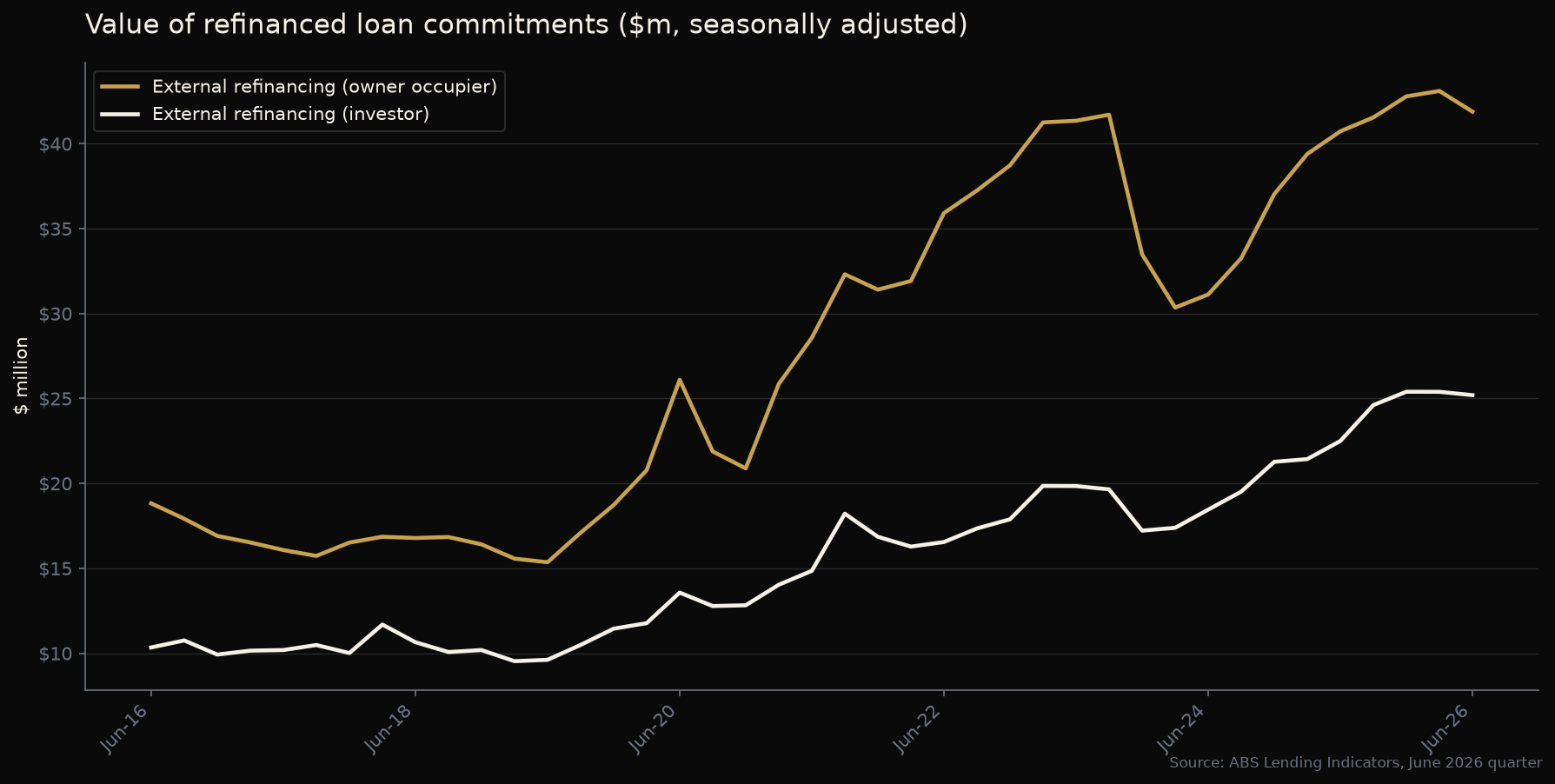
Data and Graph Sources
The official graphs
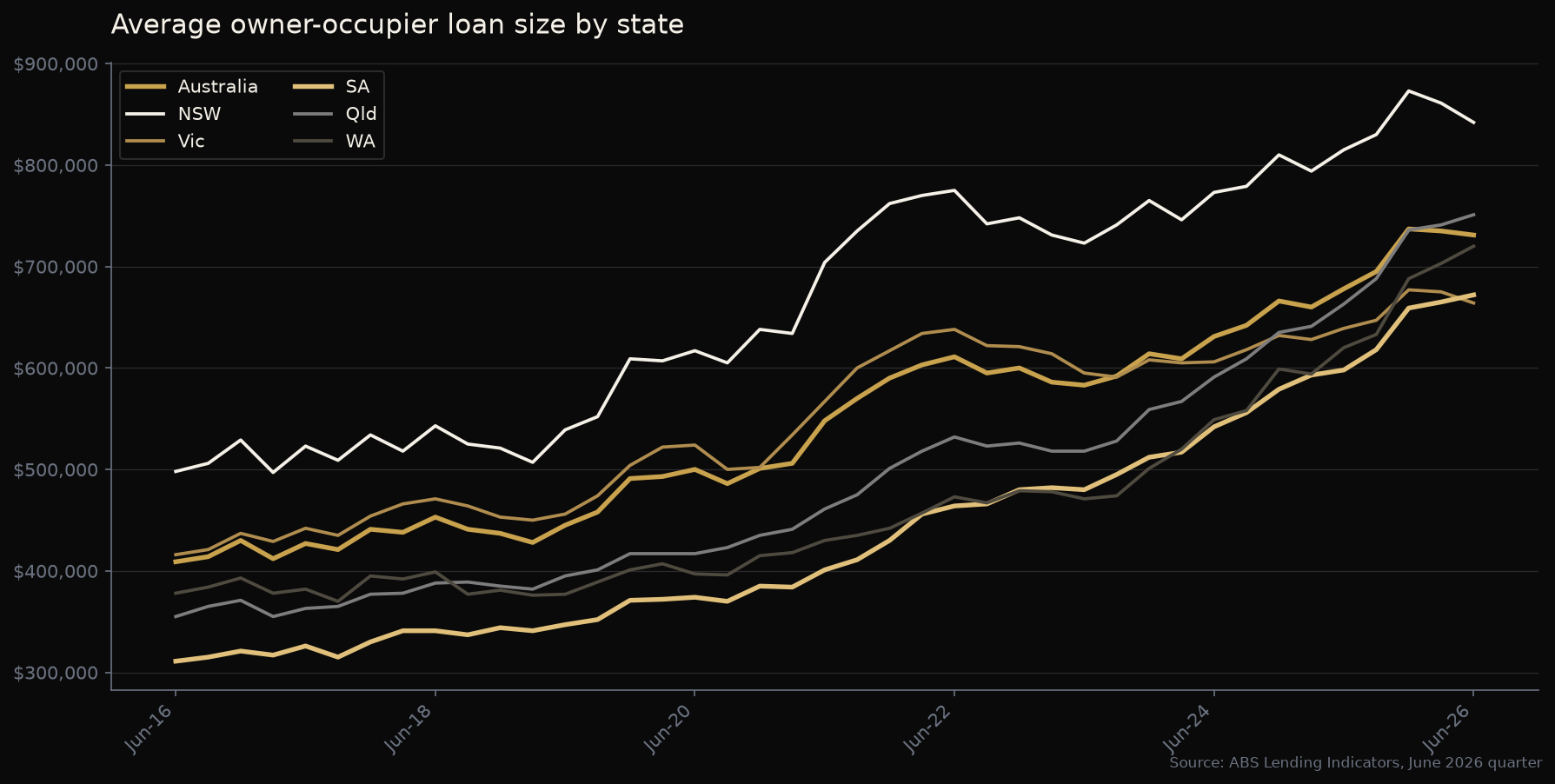
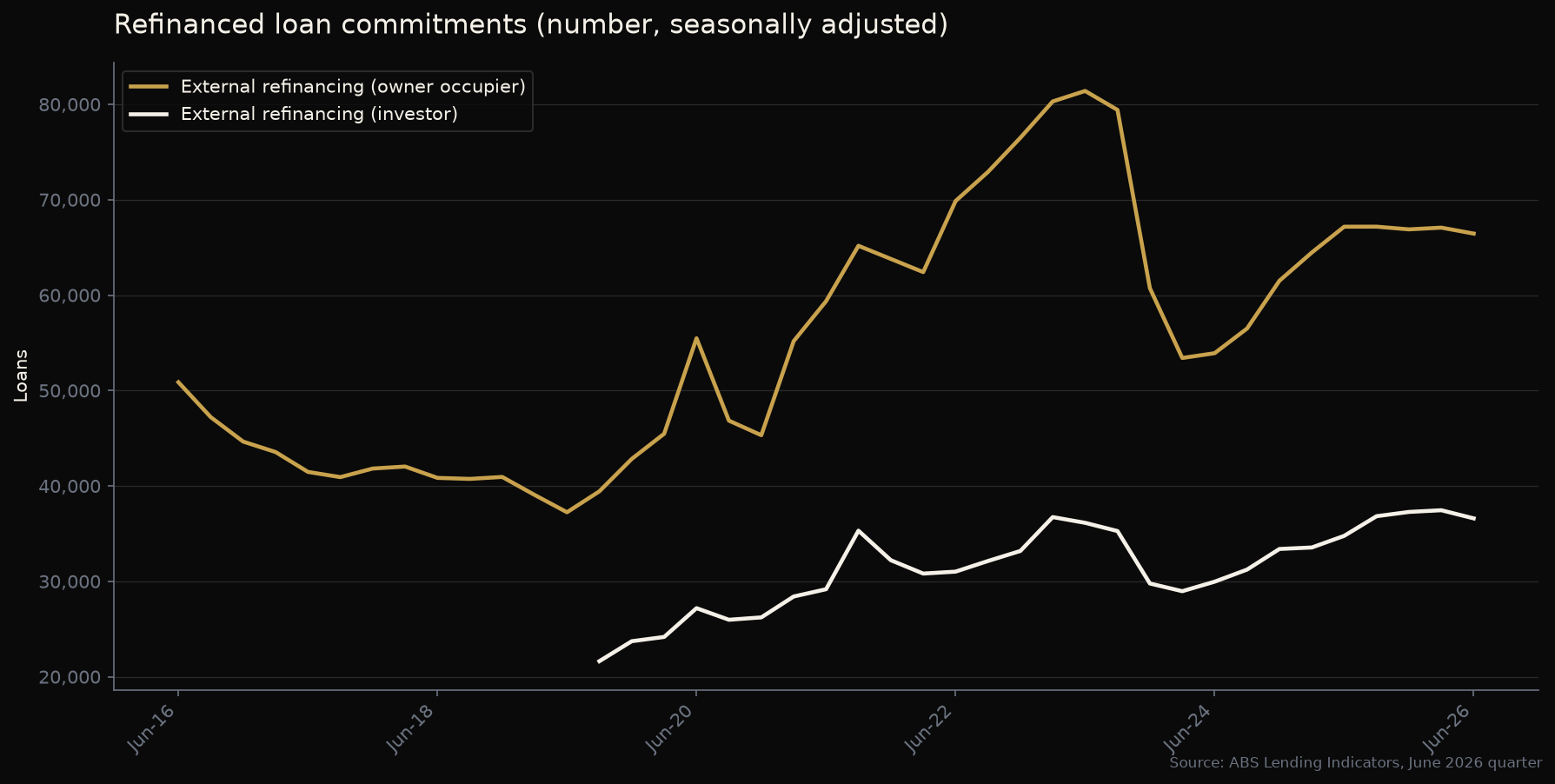
Extracted from the ABS Lending Indicators release (June 2026 quarter) cited below, restyled for this report. Figures are unchanged from the source data.
Reserve Bank of Australia
Financial Conditions, Statement on Monetary Policy, August 2026. Includes RBA graphs covering the cash rate, mortgage repayments, housing credit growth and new housing loan commitments.
https://www.rba.gov.au/publications/smp/2026/aug/financial-conditions.html
Australian Bureau of Statistics
Lending Indicators, June quarter 2026. Includes downloadable graphs and the underlying housing finance statistics for owner-occupier and investor lending.
https://www.abs.gov.au/statistics/economy/finance/lending-indicators/latest-release
Australian Bureau of Statistics
New home loans fall 5.4 per cent in June quarter
https://www.abs.gov.au/media-centre/media-releases/new-home-loans-fall-54-cent-june-quarter
APRA
Activation of debt-to-income limits as a macroprudential policy tool
https://www.apra.gov.au/news-and-publications/activation-debt-income-limits-macroprudential-policy-tool
APRA
Explanation of the debt-to-income lending limits
https://www.apra.gov.au/news-and-publications/activating-debt-income-limits-macroprudential-policy-tool
This article contains market commentary and the author's opinions regarding possible future market conditions. Forecasts are inherently uncertain and should not be interpreted as personal financial or investment advice.
Keep reading
Five Years That Changed Adelaide
Where the South Australian market heads through 2026 and 2027.
Downsizing in a Buyer's Market
Why selling first can put downsizers in the box seat.
Get a current market appraisal
Today's comparable sales, today's enquiry, today's number.
All research and reports
Our full library of market analysis and data.